
 By
By Virtual Reality (VR) is rapidly reshaping the landscape of education and professional training. By creating immersive, interactive environments, VR enables learners to experience concepts instead of simply reading or hearing about them. From classrooms to corporate training centers, this technology is redefining how knowledge is delivered and absorbed.
Unlike traditional learning methods that rely heavily on textbooks and lectures, VR offers experiential learning. Students can explore historical events, conduct science experiments, or practice technical skills within realistic virtual environments, making learning more engaging and effective.
What Is Virtual Reality in Education?
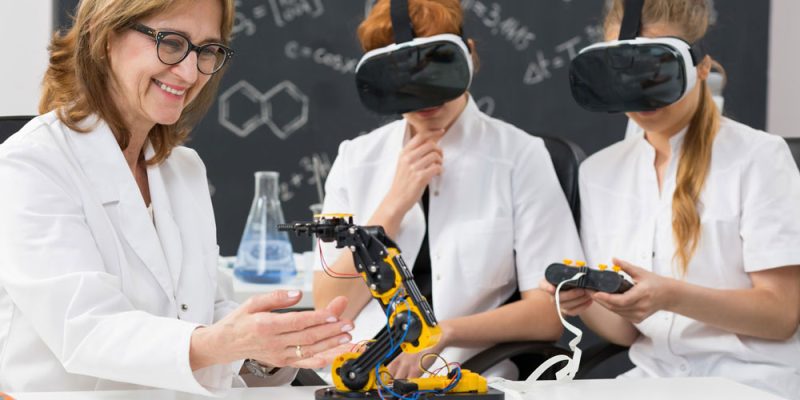
Virtual Reality in education refers to the use of VR headsets and immersive software to create simulated learning environments. These environments allow students and trainees to interact with digital objects and scenarios as if they were real.
Key components typically include:
- VR headsets that provide a 360-degree immersive experience
- Interactive simulations that replicate real-world situations
- 3D environments designed for exploration and experimentation
- Motion tracking systems that respond to user movement
Through these tools, learners can step inside complex systems, historical settings, or dangerous environments without physical risks.
Why VR Is Gaining Popularity in Learning
Several factors are driving the adoption of VR in schools, universities, and workplaces.
Increased Engagement
Traditional teaching methods can sometimes struggle to hold students’ attention. VR solves this by placing learners inside the lesson.
Students can:
- Walk through ancient cities
- Explore the human body in 3D
- Participate in simulated science experiments
This interactive participation improves focus and motivation.
Improved Knowledge Retention
Research suggests that experiential learning helps people remember information longer. When learners actively participate in a simulation, the brain processes the experience similarly to real-world events.
This means students often retain complex information more effectively compared to passive learning methods.
Safe Learning Environments
VR allows learners to practice risky or expensive tasks safely.
Examples include:
- Medical surgery simulations
- Firefighter training scenarios
- Industrial machinery operations
Mistakes can be made and corrected without real-world consequences.
Applications of Virtual Reality in Education
VR is being used across multiple educational fields, each benefiting from immersive learning experiences.
Medical and Healthcare Training
Medical schools are increasingly using VR to simulate surgeries and patient care scenarios.
Benefits include:
- Practicing surgical procedures in a risk-free environment
- Learning anatomy through detailed 3D models
- Simulating emergency medical situations
Students can repeat procedures multiple times until they gain confidence and mastery.
Science and STEM Education
VR allows students to visualize scientific concepts that are difficult to observe directly.
For example:
- Exploring molecular structures
- Simulating space exploration missions
- Conducting physics experiments in virtual laboratories
These experiences help students grasp abstract scientific ideas more easily.
History and Cultural Studies
History lessons can become immersive journeys rather than textbook summaries.
Students can:
- Walk through ancient civilizations
- Witness historical events recreated in virtual environments
- Explore archaeological sites digitally
This transforms history into an engaging storytelling experience.
VR in Corporate Training
Virtual Reality is also transforming workplace training programs across industries.
Skill-Based Training
Many companies now use VR to train employees in tasks that require precision and practice.
Industries benefiting from VR training include:
- Manufacturing
- Aviation
- Construction
- Healthcare
Employees can rehearse complex tasks before performing them in real environments.
Soft Skills Development
VR is also effective for training interpersonal skills.
Common applications include:
- Leadership development simulations
- Customer service training
- Conflict resolution scenarios
These simulations help employees practice communication and decision-making in realistic situations.
Advantages of VR in Education and Training
Virtual Reality offers several advantages over traditional learning methods.
1. Immersive Learning
Learners feel present in the environment, increasing engagement.
2. Hands-On Experience
Students learn by doing rather than just observing.
3. Personalized Learning
VR platforms can adapt to different learning speeds and styles.
4. Cost Efficiency Over Time
While initial setup may be expensive, VR reduces long-term training costs.
5. Accessibility to Remote Learning
Students can participate in immersive learning experiences from anywhere.
Challenges of Implementing VR in Education
Despite its potential, VR adoption still faces several challenges.
High Initial Costs
VR hardware, software development, and infrastructure require significant investment, which may be difficult for some institutions.
Technical Limitations
Some VR systems require powerful computers and stable connectivity, which may not be available in all schools.
Learning Curve for Educators
Teachers and trainers need proper training to integrate VR effectively into their teaching methods.
The Future of Virtual Reality in Learning
The future of VR in education looks promising as technology continues to evolve.
Emerging trends include:
- AI-powered VR learning environments
- Collaborative virtual classrooms
- Affordable standalone VR devices
- Integration with augmented reality (AR)
As costs decrease and technology improves, VR could become a standard component of modern education systems.
Educational institutions, corporations, and training organizations are already investing heavily in immersive learning platforms, signaling a shift toward more interactive and experiential education.
Conclusion
Virtual Reality is transforming education and training by making learning immersive, interactive, and practical. From medical simulations to corporate skill development, VR allows learners to experience concepts in ways that traditional methods cannot provide.
Although challenges such as cost and technological limitations remain, ongoing advancements are making VR increasingly accessible. As adoption grows, immersive learning environments are likely to play a major role in shaping the future of education and workforce training.
Frequently Asked Questions (FAQs)
1. What is the main purpose of virtual reality in education?
The primary goal of VR in education is to create immersive learning environments where students can interact with concepts, simulations, and scenarios to improve understanding and retention.
2. How does VR improve learning outcomes?
VR improves learning by offering hands-on experiences, interactive simulations, and visual representations that make complex concepts easier to understand.
3. Is virtual reality expensive for schools?
Initial setup costs can be high, but prices are gradually decreasing as VR hardware becomes more accessible and widely adopted.
4. What industries benefit most from VR training?
Industries such as healthcare, aviation, manufacturing, construction, and emergency services benefit greatly from VR-based training simulations.
5. Can VR replace traditional classrooms?
VR is unlikely to completely replace traditional classrooms, but it can significantly enhance teaching methods by providing immersive learning experiences.
6. Are VR learning environments safe for students?
Yes, VR learning environments are generally safe when used appropriately and for limited durations to avoid motion discomfort or eye strain.
7. What technologies work alongside VR in education?
Technologies like artificial intelligence, augmented reality, and advanced learning management systems are often integrated with VR to create more dynamic educational experiences.